


It’s that time of year again when the Ides of March are upon us once again. Dusting off my copy of Shakespeare’s Julius Caesar, I was eager to do a little distant reading (rather than traditional “close reading”) of the play. I had a specific question in mind: According to the data, what are the main topics Shakespeare explores in his play, and how do they relate to each other?
As I am want to do here on Plotting Plots, I turned to the literary data. In this case, I sorted every word in Julius Caesar by its frequency of use. Then, I scoured the Top 100 words to pluck out those that were neither character names nor stop words. (Stop words are functional words like and and the.)
The resulting list of Top 50 words included few surprising key words: blood, body, boy, brother, capitol, citizen, countrymen, crown, day, dead, death, die, eyes, fear, fell, fellow, fire, fly, follow, friend, gods, hands, hear, heart, home, honor, honorable, house, life, live, love, march, mighty, mine, night, noble, peace, read, roman, rome, run, servant, soothsayer, speak, spirit, sword, time, word, world, wrong.
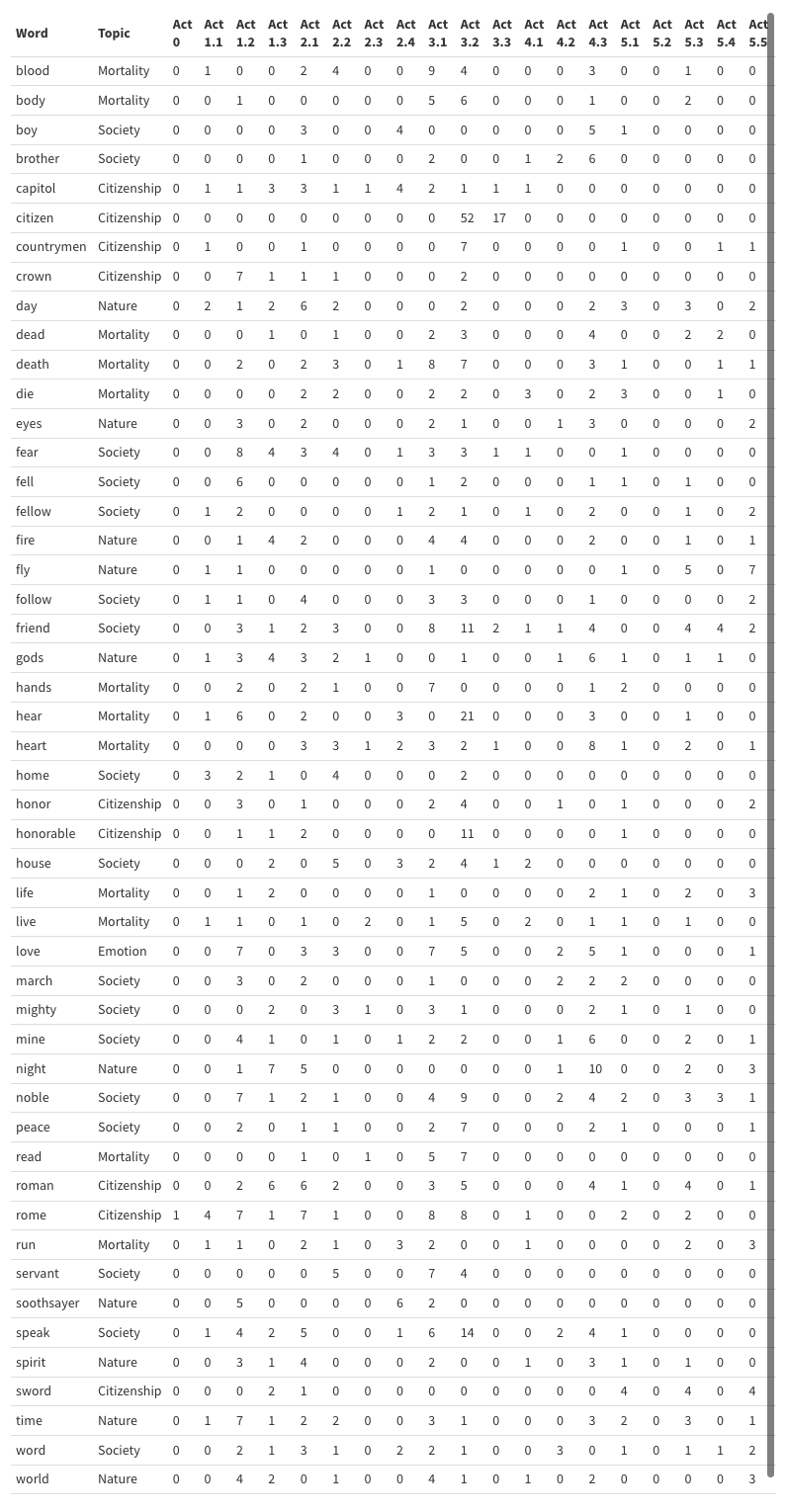
I then matched each keyword with a main topic Shakespeare explores in the text.
So what insights emerged for me? Aside from being thoroughly hypnotized by the visualization in action (it reminds me of Hans Rosling’s famous TED Talk), I was struck by one thing.
Whereas topics rise and fall in dominance in most acts in the play, that is not the case in Act 3. In fact, all of Act 3 is dominated by a single topic: citizenship. Actually, it is the single word citizen that is used with jaw-dropping frequency in the middle of Shakespeare’s play.
Act 3 is typically when the Bard’s plays heat up. That’s where the real drama starts, which is certainly the case in Ceasar. It is here that the conspirators betray Caesar, that Anthony delivers his famous address to the masses, and Anthony successfully (and so artfully) turns the crowds on Brutus and Casear’s killers.
The reason the citizen appears so often, however, is complicated. The word does appear often in the play, but most of its uses are in reference to characters with the word in their title (i.e. First Citizen, Second Citizen). I first saw this realization as a frustrating error on my part. After all, I eliminated other character names and should have perhaps done so for citizen.
But when I looked closer, I discovered something so fascinating that it rendered my misstep serendipitous. The word citizen is only uttered once by a character in Act 3. Just once. Anthony uses the word when he is finalizing his subtle masterful manipulation of the masses toward mutiny.
Here is the will, and under Caesar’s seal.
To every Roman citizen he gives,
To every several man, seventy-five drachmas.Anthony, Act 3, Scene 2 in Shakespeare’s Julius Caesar
Anthony’s sparse use of the word contrasts with the playwright’s frequent reliance on the word in his script. And that’s the insight for me. Just as Anthony galvanizes crowds to turn on Caesar’s murderers by praising their judgment and intentions, so too does Shakespeare issue a treatise on the responsibilities of citizens to hold their officials accountable by uttering the actual word only sparingly.
It is something in my many readings of the play I had never noticed. And something I would hardly have discovered for myself were it not for the kind of playful exploration that literary data and visualizations encourage.
Check out the full data viz animation here.