


I first read E.M. Forster’s A Room with a View in high school, where my teacher showed clips from the movie adaptation. The film opens with Puccini’s “O mio babbino caro,” a soprano pleading with her father for the freedom to marry her love. As a young singer myself, I felt a kinship with that cry for freedom. Years later, when I taught the novel to my own high school students, my focus returned to the role of music, just as protagonist Lucy Honeychurch returns throughout the novel to the piano.
Torn between the suffocating expectations of Edwardian society and the muted cries of her own spirit, readers meet Lucy in the throes of repression-induced ennui. She has all but succumbed to the force of a mighty invisible thumb pressing down upon her.
There are, however, hints of authenticity and joy that escape Lucy’s state. After observing Lucy perform a song at church, Reverend Beebe remarks to the vicar:
“If Miss Honeychurch ever takes to live as she plays, it will be very exciting both for us and for her.”
Forster ominously adds via the narrator: “Lucy at once re-entered daily life.”
The author’s own cadence in that last sentence resonates. The words at and once seem to stomp commandingly, as if Lucy’s artistic expression were suspended and ridiculed by some unseen power that needed no permission to shout in God’s house. On a Sunday, at that.
So while it is true that musical diction appears throughout the novel, it does not always appear uniformly. When one tallies how often such words surface and when, a pattern emerges that, for me, confirms what I have always believed about this book.
Music acts not as Lucy’s soundtrack, but rather as her anthem.
At times, Lucy literally plays her own music, asserting her creativity in an act of self-expression. She does this near the novel’s opening and again near its ending. In between, however, it is Forster who ensures musicality remains present in the prose. As if he knows his character is empowered by such diction and will need it to break free.
Between chapters 6 and 15, musical language ebbs and flows like a modern heart monitor or sound wave. It grows.
Counting the Music
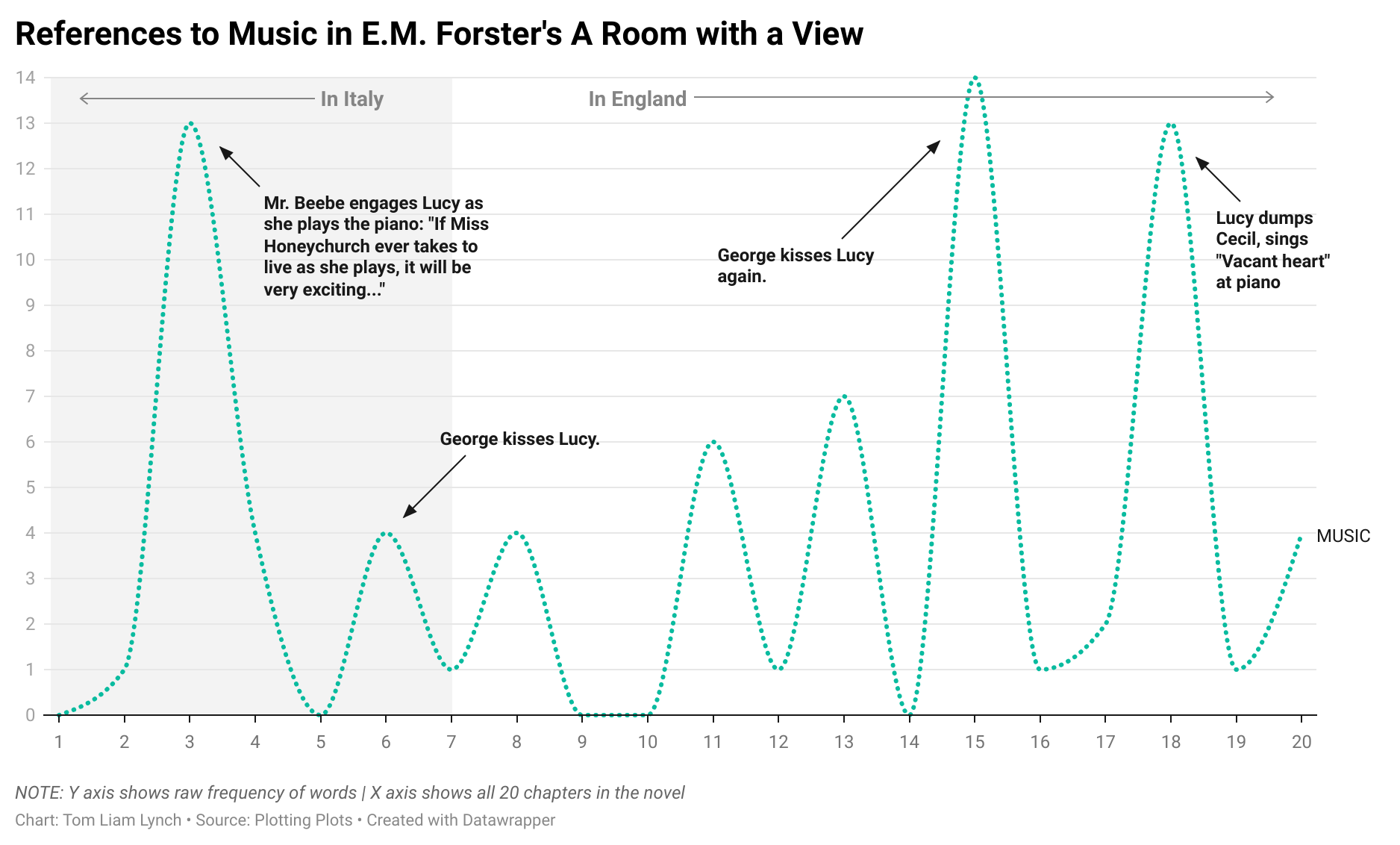
The line chart above shows the frequency with which Forster used musical diction throughout the text. Words I noted include: chords, chorically, concerts, harmony, melody, music, musical, musicians, piano, singer, singing, sings, song, and songs. Since the novel divides into two parts (first in Italy, then in England), I mark the shift in settings as well.
Music represents Lucy’s true self, uncontorted by the pressures and proprieties of Edwardian expectation. We see this most clearly in the development arc surrounding her two kisses with George Emerson.
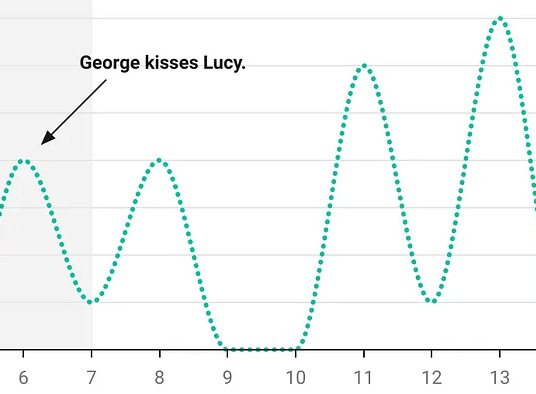
In Chapter 7, George surprises Lucy with a kiss among the violets on a hillside outside Florence. The moment arrives without warning or permission; it is impulsive, physical, almost alarmingly sincere. Lucy recoils. She retreats into the safety of convention, and the novel’s musical vocabulary retreats with her. Look at the chart: between chapters 8 and 10, musical references plummet nearly to zero.
The piano falls silent. Forster’s prose grows arid, as if the very language of feeling has been confiscated. Lucy returns to England, where drawing rooms replace Tuscan hillsides and decorum replaces candor. She accepts a proposal from Cecil Vyse, a man who treats her less like a companion and more like a painting to be admired behind glass.
Then, gradually, the music returns. By chapter 13, musical diction begins to creep back into the text. The frequency rises, dips, rises again; the rhythm of a pulse quickening. George reappears in Lucy’s English world, and in Chapter 15, he kisses her a second time. This kiss is different. It does not ambush her in a field of wildflowers. It arrives in a garden she knows, on ground she occupies by choice, and this time she does not flinch. The chart surges: chapter 15 registers the novel’s highest concentration of musical language, fourteen references in a single chapter. Forster floods the prose with the vocabulary of sound, as though the orchestra has finally been unleashed.
The Anthem Builds
What strikes me about this pattern is not merely the correlation between kisses and music but the trajectory. After the first kiss, silence. After the second, crescendo. The intervening chapters trace a slow, fitful reawakening; Lucy’s inner music gathering force beneath the polite surface of her repression. Forster seems to know, even when Lucy does not, that she will need this vocabulary to survive the choices ahead.
And she does. In Chapter 19, Lucy breaks off her engagement to Cecil. She sits down at the piano and sings a song from an opera in which the heroine sings with a “vacant heart.” The moment is devastating in its self-awareness. Lucy plays the music herself, choosing both the instrument and the lyric. She is no longer Forster’s marionette, animated by his diction; she is a character seizing the very language that has carried her through the novel. The chart confirms what the scene dramatizes: musical references spike again, soaring to thirteen in the penultimate chapter.
By the final chapter, Forster brings Lucy and George back to Florence, back to the room with a view where everything began. Musical references settle to a gentle four, a quiet coda. The anthem has been sung. What remains is not silence but something rarer: peace.
Why Count?
Some readers may wonder why I bothered tallying words at all. Can a spreadsheet really illuminate a love story? I think it can, though not in the way we might expect. Quantitative literary analysis does not replace interpretation; it refracts it. The numbers gave me something I could not get from reading alone: a shape. I could feel the music in Forster’s prose when I read it, but I could not see its architecture until I charted it. The valleys between chapters 8 and 10 confirmed a hunch I had carried for years, that Lucy’s repression is not just thematic but structural, woven into the very frequency of Forster’s word choices.
This is what I mean when I talk about inviting software, including AI, to read with us. The spreadsheet does not tell us why Forster chose the word harmony or placed a piano in a particular scene. That work belongs to human readers, to students debating in classrooms, to teachers pressing their classes to wonder aloud. What the spreadsheet offers is a new vantage point: the view from above, the landscape of a novel rendered visible in a single image. From that vantage, patterns emerge that the ground-level reader might sense but cannot prove.
Reverend Beebe was right, of course. Lucy Honeychurch did take to living as she played. And Forster, the quiet conductor of her liberation, scored every measure.