


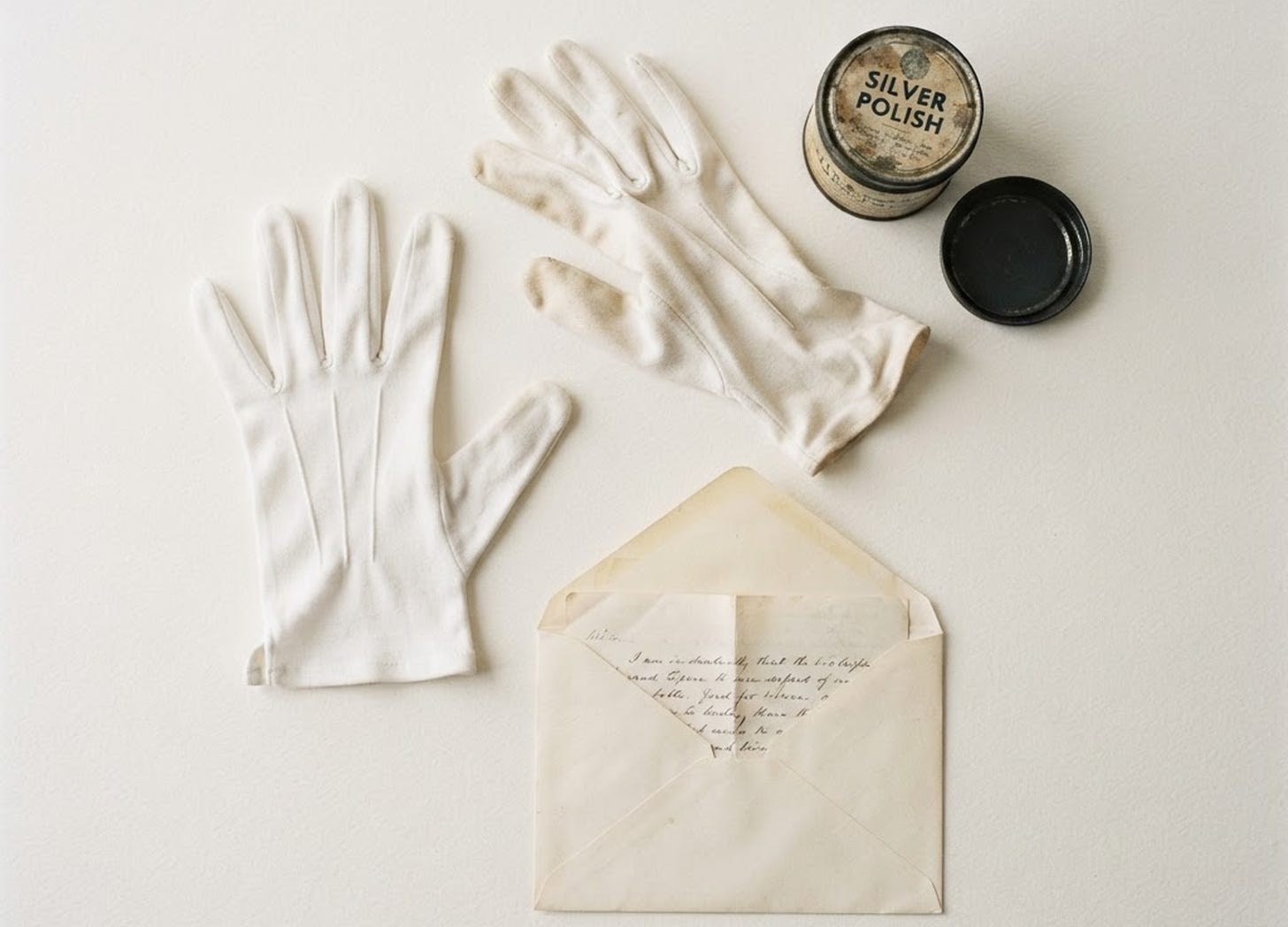
In Kazuo Ishiguro’s The Remains of the Day, Mr. Stevens is an aloof English butler grappling with the arrival of a modern era that renders his role in the world obsolete. Stevens had proudly served Lord Darlington for most of his career. After Lord Darlington passed away, hardly peacefully given the controversy he stirred up by unwittingly supporting Nazism, his estate was bought by a wealthy American called Mr. Farraday.
Stevens came with the estate. He struggled to transition into his new environment—same house but reduced staff and a new boss whose irreverence for tradition is embodied in his own very purchase of such an estate. When Mr. Farraday insists Stevens take some time to himself, he even offers his car so Stevens can visit the countryside. An American Ford, of course.
Stevens identifies completely with his role as butler and the precarious classist society that such a role requires. He puts his work above all else and permits the world, at least based on his accounts, to see only his professionalism. In the end, his unique form of cowardice (a harsh word, but I believe an accurate one) costs him dearly.
Examples abound. Stevens chose to serve Lord Darlington during an important dinner event rather than be at his dying father’s bedside upstairs. Stevens chose to serve guests as he ignored the feelings he had for his colleague, Ms. Kenton, and meets her attempts to engage with him with insulting urbanity. In turn, and to her credit, Ms. Kenton left her post in an act of self-dignity and -preservation.
I confess that I struggled through the book because I didn’t find Mr. Stevens very interesting. The movie, which I have not watched on principle, does appear more engaging to me than the book.
Back to the Book!
My indifference did teeter, however, in one scene and in response to one particular word.
The scene was about three quarters of the way through the novel. Stevens is serving at an event and, reservedly, speaking to young Mr. Cardinal about whether Lord Darlington is fully aware of the potentially disastrous political implications of some of his social activities. Mr. Cardinal asks:
“You care deeply [about Lord Darlington], you just told me. If you care about his lordship, shouldn’t you be concerned? At least a little curious?”
Curiosity is not something I associated with Stevens (nor would he be curious enough to associate it with himself). In fact, his disposition is fundamentally uncurious. Social norms and etiquette dictate his actions and words. That is his whole profession, and being.
The word curious was not all that struck me. So did the question mark itself. I didn’t associate Stevens with question marks, unless his inquiry was to clarify his lordship’s directive. Stevens was more of a period kind of chap. Certainly no ellipses…or dashes—maybe some commas, and, consciously chosen, semicolons; question marks did not become him.
However, when one looks at how frequently question marks are used in the novel, an interesting pattern emerges. Question marks often accompany sections significantly involving…Miss Kenton.
The chart led me to skim through the book again looking for question marks, especially involving his love interest. One in particular struck me. In the novel’s final section, Stevens sits on a pier after leaving Miss Kenton to her new life. He reflects to the reader:
“Indeed - why should I not admit it? - at that moment, my heart was breaking.”
After so many pages of etiquette and manners and protocols and such, Stevens finally offers an honest emotional offering to the reader. And the syntax of the sentence suggests to me a causal relationship between Stevens’s vulnerability and the question mark. His inquiry does not stand on its own, but rather is forced into his thought abruptly via dashes—as if necessary to his confession.
Stevens, in the final scene of the novel, embodies the deepest regret. Isn’t all regret the result of past-rooted questions to which the present has no reply? Were I greeted by such an honest and curious narrator when I began the book, I might have read the novel with intrigue and joy.
Instead…
I mostly found myself cosmically bored by and uninterested in Mr. Stevens. The sentences went on and on and on and on. I didn’t know who the narrator–Stevens himself–was talking to half the time. And if he was talking to me he severely misjudged his audience. At times it felt like reading his diary, which I had no desire to do. Though, I did find it ironic when Stevens, in several scenes, declared his intention to get better at “banter” as he called it. Surely someone so consciously terrible at speaking to others in any way other than mechanically should not spend 245 pages telling his own story. The novel’s author, Nobel prize winner though he be, should have seen this flaw and could at least done this reader the courtesy of third-person narration.
Still, my dislike for Mr. Stevens did have its upside: it made counting punctuation marks far funner than I could possibly have imagined otherwise.